

Mayor Schember and City of Erie Police Department Mark Mental Health Awareness Month
Pennsylvania State Representative Bob Merski presented a check for $127,000 in State Grant funding for the Crisis Negotiation Team
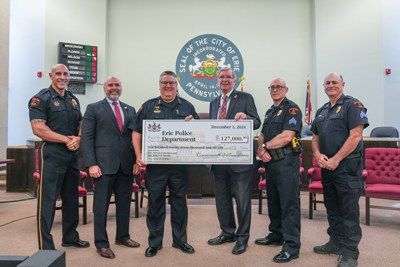
Erie, PA - May 15, 2025 Today, to mark Mental Health Awareness Month, Erie Mayor Joe Schember, Erie Police Department (EPD) officers Lt. Jamie Russo, Sgt. Marc Bellotti, and Sgt. Tom Covatto, along with Crisis Services Program Director Stacey Buettner, explained the recent initiatives implemented by the EPD to handle increased calls dealing with homelessness, mental and behavioral issues, substance use disorders, crisis situations, violent crime, and domestic disturbances.
EPD's Assist Other Agencies Calls went from 2,353 in 2018 to 3,099 in 2023. In addition, EPD responded to 59,399 calls for overall service in 2023, up from 45,000 in 2020.
In 2021-22, after obtaining feedback from community and neighborhood groups, service providers, mental and behavioral health experts, the District Attorney's Office, Erie's Public Schools, the County Criminal Justice Advisory Board, and the Mercyhurst Civic Institute, the City of Erie allocated $12M in ARP Funding to reinstate the Crisis Car and the Juvenile Unit, and to add 4 officers to the Neighborhood Action Team (NAT), for a total of 18 additional officers. The unit was reinstated by EPD Chief Dan Spizarny on May 1, 2023.
The Crisis Car is composed of 9 officers, who have completed specialized training in de-escalation strategies and how to handle mental and behavioral health crises, substance use disorders, domestic violence, and suicidal individuals. The last time the EPD had the Crisis Car was in the early 2000's when it was discontinued due to budgetary constraints.
In 2024, the Crisis Unit responded to 3,468 calls for service. These included 467 mental health outreaches, 518 welfare checks, 146 voluntary commitments, 425 involuntary commitments, 663 verbal domestics, 43 physical domestics, and 1,604 non-crisis calls.
The EPD Crisis Unit has been assisted in its work through a co-responder program with Crisis Services that began on April 22, 2024. In its first year, Crisis Service clinicians have responded to 442 calls with EPD, resulting in improved response time to calls involving individuals with behavioral health concerns.
In addition to reinstating the Crisis Car, the City is proud to announce a State Grant has been awarded to EPD's Crisis Negotiation Team, formerly known as the Hostage Negotiation Team.
This team of officers is called on when there is the threat of harm to a person or people by another who may, for example, be holding them against their will. The person could be a barricaded criminal, who is suicidal and/or has a hostage. Fortunately, incidents such as these are rare, but EPD must be prepared for them and have the best equipment available so the officers can use their skills to try to resolve them in a peaceful manner.
To support this team in its work, Representatives Bob Merski and Pat Harkins helped the City obtain a State Grant for $127,500 to obtain a Crisis Communication Vehicle. The old vehicle was a 30-year-old former ambulance with 240,000 miles on it. Due to its age and condition, the vehicle was outdated, unreliable, and often out of service for repairs. The newer vehicle will serve as a Negotiation Operations Center, complete with desks, monitors, and communication equipment used to manage critical incidents. It will also be used to adequately store all of EPD's negotiation and communication equipment in one place for easy accessibility, and serve as a private, safe space for crisis negotiators to counsel those in crisis while continuing to de-escalate situations.
This piece of equipment is going to be invaluable and the City extends its gratitude to Representatives Merski and Harkins, and Erie County District Attorney Elizabeth Hirz, who is providing additional funding for the Team.
Finally, because national statistics show that police officers experience 188 critical incidents during their career, vs. 1-2 for the regular person, and police officers are as likely to die from Suicide as in a line of duty death, the EPD has started two programs to assist officers to handle mental health.
First, EPD created the Critical Incident Stress Management (CISM) Team of officers who are specially-trained to meet with officers immediately after a Critical Incident to go over different reactions that they may encounter as a result of their experience. EPD's goal is to meet with officers as soon as possible so the effect of a critical incident will not set in. The CISM Team points out reactions they may be having or might encounter in the future. This team is available to officers 24/7 if they have questions or if they just want to talk.
Second, EPD will soon be starting Erie Police-Blue Assist (PEER Program). This program is a group of active and retired officers that have been trained through the National Fraternal Order of Police-Power in PEERs Program. EPD is trained specifically to assist active officers and retired officers with problems from within or outside the job that they may be experiencing.

Connect With Us