

MAP Report Reveals the Growing Extremism of Efforts to Eliminate Medically Necessary Care for Transgender People in the U.S.
Nearly 1 in 5 Transgender Youth Live in a State Where Medically Necessary Care is Banned
Bills to ban best-practice medical care for transgender people are growing in number, growing in scope, and growing more extreme, according to a report released today by the Movement Advancement Project (MAP). The new MAP report, LGBTQ Policy Spotlight: Bans on Medical Care for Transgender People, provides the most comprehensive look to date at the sweeping attempts to ban and restrict medical care for not only transgender youth-but also transgender adults. Just last week, Missouri became the first state to effectively ban medically necessary care for both youth and adults.
MAP analyzed the more than 250 bills introduced in recent years that attack access to medical care for transgender people. These bills come amid a broader climate of record-breaking anti-LGBTQ efforts: this year alone, state legislatures have introduced more than 650 bills attacking LGBTQ people, including more than 125 bills that would specifically ban or limit transgender people's access to health care.
(Please note: the report includes updates as of April 15, 2023. Due to this quickly changing political landscape, please refer to our Equality Maps, which are updated in real time, or contact media@mapresearch.org)
Through this detailed analysis, the new MAP report illustrates the extent of how recent bills targeting medically necessary care for transgender people are expanding and becoming more extreme, including:
- Expanding from youth under 18 to include adults.
- Ever-growing penalties for providing this medically necessary care, including felony or even child abuse charges for healthcare providers, parents, and even teachers.
- Efforts to ban any insurance coverage for care, including through both state-funded programs like Medicaid and through private insurers.
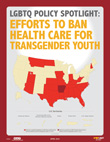
Prior to 2021, no states banned medical care for transgender youth, but now 15 states have bans on at least some forms of medical care, and many more states are actively pursuing similar bans. As a result, nearly one in five (20%) transgender youth currently live in states where they are banned from receiving best-practice medical care, in addition to transgender adults living in Missouri.
"These bills are part of a much broader, coordinated effort to prevent transgender people from being our authentic selves," said Logan Casey, Senior Policy Researcher at MAP and an author of the report. "Across the country, anti-transgender extremists and politicians are putting the lives and well-being of transgender people at risk by attempting to outlaw access to best practice medical care not only for youth, but for all transgender people."
Snapshot of the broader policy landscape impacting access to health care for transgender people (outlined in more detail in the report):
- Fifteen states have bans on at least some forms of medical care for transgender youth, including one state that effectively bans care for transgender adults as well. Not all of these bans are in effect yet.
- More than half of states still lack explicit health insurance nondiscrimination protections for transgender people.
- At least nine states explicitly ban Medicaid from covering medically necessary health care for all transgender people, and another two ban this coverage for minors. Since more than one in five transgender people live in poverty, this further limits the ability of many transgender people to receive important medical care.
- Nearly a third (32%) of Black transgender people live in the states that currently ban best-practice medical care for transgender youth. Laws targeting medically necessary care for transgender people disproportionately harm transgender people of color, who already face obstacles to accessing health care due to discrimination and economic insecurity.
Snapshot of legislative attempts in 2023 and recent years to block medically necessary care for transgender people (outlined in more detail in the report):
- Just three months into 2023, more bills attacking access to health care for transgender people have been introduced than in the last six years combined.
- Nearly three in 10 (29%) bills introduced in 2023 would ban or restrict care for both transgender children and transgender adults.
- Nearly half of bills this year would prevent state funding for medical care for at least some transgender people, such as through state employee health plans and Medicaid.
- Since 2020, roughly one out of seven (14%) bills would ban or restrict private insurance companies from covering or reimbursing the costs of best-practice medical care for transgender people, or would explicitly allow insurance companies to refuse coverage outright.
- The most common penalty in these bills is to revoke the medical license of-or otherwise punish-healthcare providers through the state's professional licensing board.
- The number of bills that make it easier for people to sue doctors who provide medical care to transgender people nearly quadrupled from 16% in 2020 to 61% in 2023, illustrating the increasing privatization of the enforcement of these bans, similar to tactics used in anti-abortion efforts.
- More than 80% of bills attacking transgender health care also contain explicit exceptions that would allow non-consensual surgeries on intersex children, surgeries that are typically performed in infancy.
The health care targeted by anti-transgender extremists is medically necessary care that is prescribed by experienced doctors who utilize best practices that are endorsed by all major medical groups, including the American Academy of Pediatrics and the American Medical Association.
"It can be hard at first to understand what it's like to have a transgender child, but everyone should understand that these decisions should be left to parents, healthcare providers, and the patient, in accordance with best practice medical standards," said Ineke Mushovic, Executive Director of MAP. "These bills allow the state to overrule parents and take best practice medical care off the table, limiting parents' options for how to best support their child. And now they are even saying transgender adults shouldn't be trusted to make the decisions about the care they want and need."
About MAP: MAP's mission is to provide independent and rigorous research, insight and communications that help speed equality and opportunity for all. MAP works to ensure that all people have a fair chance to pursue health and happiness, earn a living, take care of the ones they love, be safe in their communities, and participate in civic life. www.mapresearch.org
LGBT Movement Advancement Project
Other LGBT Movement Advancement Project Articles
Founded in 2006, the Movement Advancement Project is an independent think tank that provides rigorous research, insight and analysis that help speed equality for lesbian, gay, bisexual and transgender (LGBT) people. MAP’s work is focused on three primary areas:

Connect With Us